How Multi-Omics Data Analytics Powers Protein and Strain Engineering
By Dr. Rajesh Biswas, Founder & CEO, Lifesystem Analytics Pvt Ltd
Biology is increasingly becoming an engineering discipline. Much like the digital revolution transformed industries through data and computation, modern biotechnology is being reshaped by the convergence of biology, engineering, and artificial intelligence. At Lifesystem Analytics Pvt Ltd, we are leveraging this convergence to design smarter biological systems that enable sustainable and economically viable biomanufacturing.
From food ingredients and enzymes to pharmaceuticals and bio-based materials, microorganisms have long served as nature’s microscopic factories. However, these organisms were not naturally optimized for industrial-scale production. The challenge is to make them more productive, robust, and commercially feasible. This is where protein engineering, strain engineering, and multi-omics data analytics come together.
Protein Engineering: Designing Better Molecular Machines
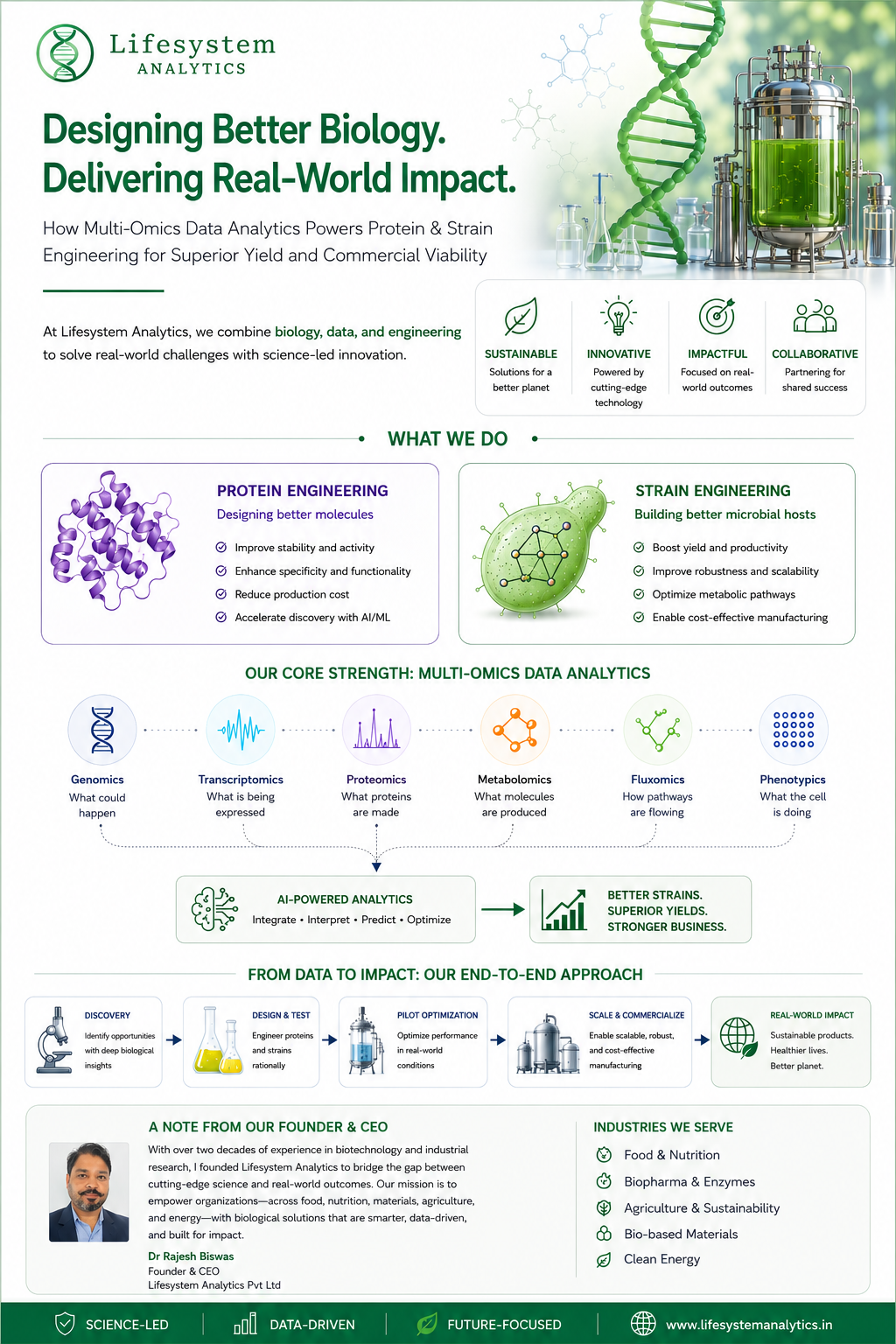
Proteins are responsible for performing most biological functions. Enzymes, therapeutic proteins, and many specialty molecules are all proteins. Through protein engineering, we can improve their stability, activity, and specificity, enabling better performance while reducing production costs. In essence, we design molecules that are better suited for industrial applications.
Strain Engineering: Building Superior Microbial Factories
Microorganisms such as yeast and bacteria are used to manufacture valuable products ranging from enzymes to alternative proteins. Strain engineering focuses on optimizing these microbial hosts to increase productivity, improve process robustness, and enhance scalability. Even modest improvements in strain performance can significantly impact manufacturing economics at commercial scale.
Why Biology Needs Data
Living systems are incredibly complex. A single cell contains thousands of genes, proteins, metabolites, and interconnected pathways. Traditional trial-and-error approaches are often slow and expensive. To truly understand and optimize biological systems, we need to observe them from multiple perspectives simultaneously.
This is where multi-omics data analytics becomes transformative.
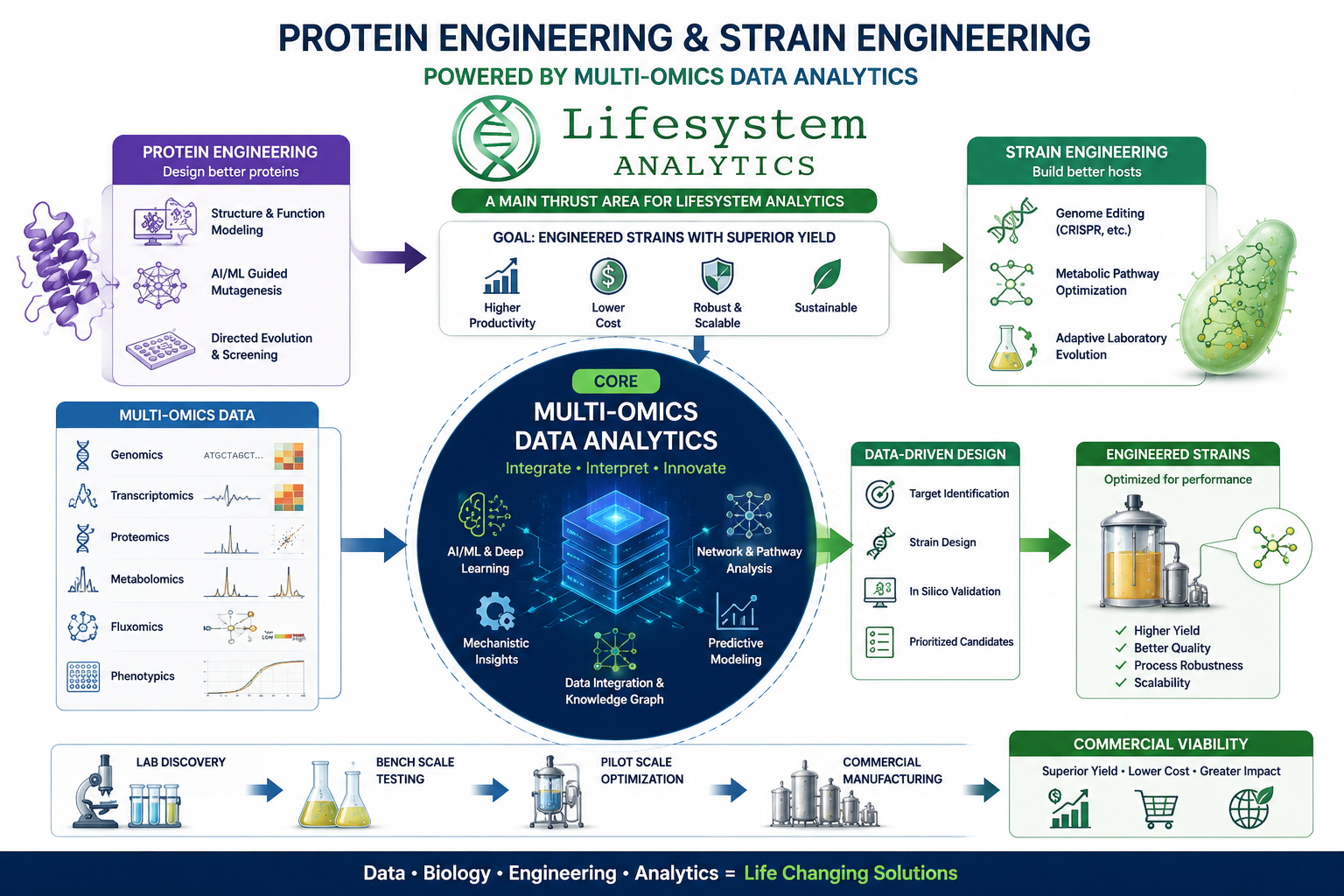
At Lifesystem Analytics, our approach integrates multiple layers of biological information:
- Genomics – understanding the genetic blueprint.
- Transcriptomics – determining which genes are active.
- Proteomics – identifying proteins being produced.
- Metabolomics – analyzing cellular metabolites.
- Fluxomics – understanding pathway dynamics.
- Phenotypics – measuring how cells behave under real-world conditions.
Individually, these datasets provide valuable insights. Together, they create a comprehensive view of cellular systems, enabling rational and data-driven engineering strategies.
From Data to Biological Intelligence
Generating data is only the beginning. The real power lies in integrating and interpreting these datasets using advanced analytics, systems biology, and AI-driven modeling. This enables us to:
- Identify metabolic bottlenecks.
- Prioritize engineering targets.
- Predict strain performance.
- Reduce experimental cycles.
- Accelerate development timelines.
- Improve scalability and commercial viability.
By transforming complex biological data into actionable insights, we help bridge the gap between scientific discovery and industrial implementation.
Our End-to-End Approach
At Lifesystem Analytics, we follow a systematic workflow that spans the entire development pipeline:
Discovery → Design → Optimization → Scale-Up → Commercialization
This integrated approach ensures that innovations developed in the laboratory translate into robust, scalable, and economically viable manufacturing processes.
Enabling the Future Bioeconomy
Our technologies support a wide range of industries, including:
- Food and nutrition
- Precision fermentation and alternative proteins
- Biopharmaceuticals and enzymes
- Agriculture and sustainability
- Bio-based materials
- Clean energy and industrial biotechnology
As the world moves toward more sustainable manufacturing, biology will increasingly become a key platform technology. The future of biomanufacturing will be driven not only by biological sciences but also by artificial intelligence, systems biology, and data analytics.
Our Vision
With over two decades of experience spanning academic and industrial biotechnology, I founded Lifesystem Analytics Pvt Ltd with the vision of bridging cutting-edge science with real-world applications. Our mission is to empower organizations with intelligent, data-driven biological solutions that accelerate innovation and enable sustainable manufacturing.
We believe that the next generation of biotechnology will be defined by the integration of biology, engineering, and analytics. By harnessing the power of multi-omics data and AI-driven insights, we are committed to designing better biology and delivering solutions that create meaningful impact for industries, society, and the planet.
Engineering Biology. Accelerating Impact.