By Dr. Rajesh Biswas, Founder & CEO, Lifesystem Analytics Pvt Ltd
Industrial protein production is often described in terms of the final product: an enzyme for food processing, a therapeutic protein, a research reagent, or a specialty protein used in manufacturing. But behind every successful production process is a much less visible foundation: the strain. The choice, design, and optimization of the production strain can determine whether a process is commercially viable, scalable, and reliable or whether it remains expensive and difficult to reproduce.
At its core, strain generation means developing a microbial cell factory that can produce a target protein efficiently and consistently. This is not just a scientific exercise. It is a business-critical step that affects yield, cost of goods, process robustness, regulatory risk, and ultimately whether a protein can reach the market at an acceptable price. Industrial strain improvement is widely recognized as a prerequisite for efficient biotechnological production, and modern strain engineering is increasingly used to raise productivity and resilience in industrial hosts.gyansanchay.csjmu.ac+2
The Strain Is the Factory
A useful way to think about industrial protein production is to imagine the strain as the factory itself. The protein is the product, but the strain determines how fast the factory runs, how stable the assembly line is, how much raw material is wasted, and whether the product meets quality expectations. If the factory is poorly designed, even the best protein sequence will be costly to make at scale.
In practice, strain generation focuses on creating a host that can express the protein at high levels while maintaining growth, stability, and product quality. That means balancing many factors at once: transcription and translation efficiency, protein folding, secretion, stress tolerance, and metabolic burden. Heterologous protein production consumes cellular resources, so engineering more burden-resilient strains is one of the most effective ways to improve both productivity and profitability.frontiersin+1
Why It Drives Economics
For investors and business teams, strain generation matters because it shapes the economics of the entire process. A better strain can reduce fermentation time, improve titers, lower downstream purification burden, and make scale-up more predictable. Small improvements in yield can have outsized effects on cost, especially when production volumes are large or margins are tight.
This is one reason why companies invest heavily in screening and engineering programs early in development. A strain that performs well in a lab flask but fails under industrial conditions can create delays and force expensive process redesign. By contrast, a strain built for production from the start can shorten development timelines and improve the probability of commercial success.gfi+2
What Good Strain Generation Achieves
A well-designed production strain does more than simply make protein. It supports the full production workflow. Ideally, it should grow reliably, tolerate process stress, and maintain output over many generations. It should also produce the desired protein in the right form, with the right folding and, where relevant, the right post-translational features.
Good strain generation can improve:
- Protein yield, by increasing expression and reducing cellular bottlenecks.
- Product quality, by improving folding, secretion, and consistency.
- Process robustness, by making the host more tolerant to stress and scale-up conditions.
- Manufacturing efficiency, by reducing variability and improving resource use.
In many cases, strain performance is the difference between a protein that is scientifically interesting and one that is commercially feasible. The importance of this step is especially clear in recombinant protein manufacturing, where the host system must work as part of an integrated production platform rather than as a simple expression tool.frontiersin+1
How Strains Are Developed
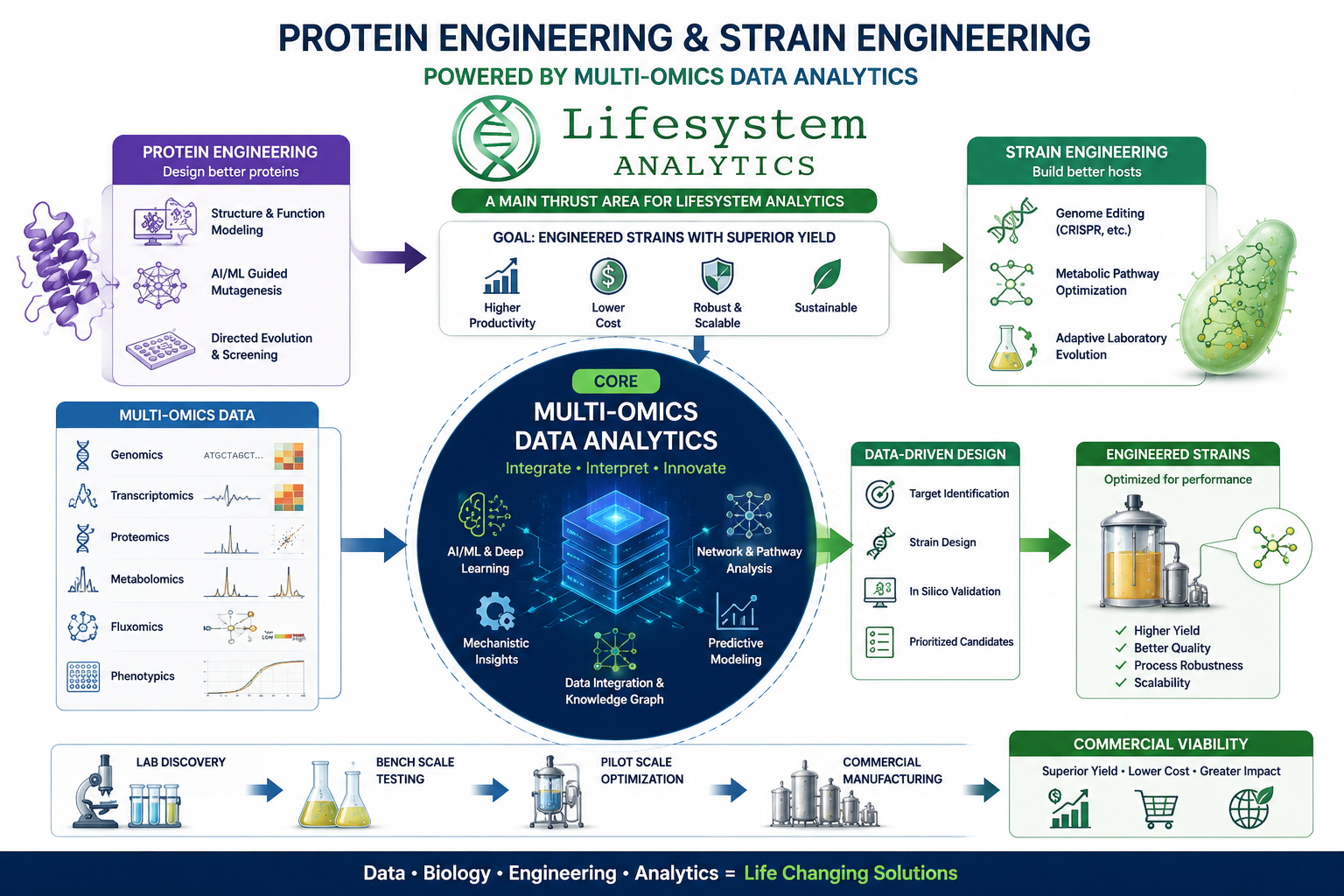
Strain generation can use a range of approaches depending on the organism and the target protein. Traditional methods include adaptive evolution and random mutagenesis followed by screening. Modern methods are more precise and often combine rational design, pathway engineering, genome editing, and high-throughput screening.
The process usually begins with identifying the right host organism. Different hosts have different strengths: some are better for secretion, others for fast growth, and others for handling complex proteins. Once a host is selected, scientists optimize it to allocate more resources to the desired product and fewer to competing pathways. The most successful programs combine biology, analytics, and process knowledge so that the strain and the fermentation process develop together rather than independently.edscl+2
Why It Matters Beyond Science
Strain generation is not only a technical issue. It affects how companies compete, how products are priced, and how quickly new biotechnology can be deployed. For industrial proteins used in enzymes, food, diagnostics, or therapeutics, production cost can be a major barrier. A strong strain development platform can help overcome that barrier by enabling efficient and scalable manufacturing.
It also supports sustainability. More productive strains typically require less raw material and energy per unit of protein. That makes them attractive for companies trying to reduce environmental impact while improving supply reliability. In a market where customers, regulators, and investors are all paying attention to efficiency and sustainability, strain generation becomes a strategic advantage rather than a back-end technical detail.gfi-india+1
The Strategic View
Companies that treat strain generation as a core capability tend to move faster and build more durable production platforms. They can adapt to new targets, new hosts, and new market demands more effectively. They are also better positioned to handle challenges such as protein misfolding, secretion stress, and scale-up failure, all of which can derail production if the strain is not engineered carefully.
For this reason, strain generation should be viewed as an investment in platform strength. It is the point where scientific design meets manufacturing reality. A well-developed strain does not just produce protein; it creates the conditions for reliable industrial success.
Closing Thought
In industrial biotechnology, the strain is often the hidden hero. The final protein may get the credit, but it is the strain that makes production possible at scale. For companies building protein-based products, serious strain generation is not optional. It is one of the most important determinants of technical performance, commercial viability, and long-term growth.